The Professional-Grade Close. No Leaks. No Agents. No Compromise. Automate your reconciliations with private ML models. Join our private beta with a 6-month free trial

Why Your Accountant is the Only "Agent" You Need
Arijit Mukherjee
3/25/20264 min read
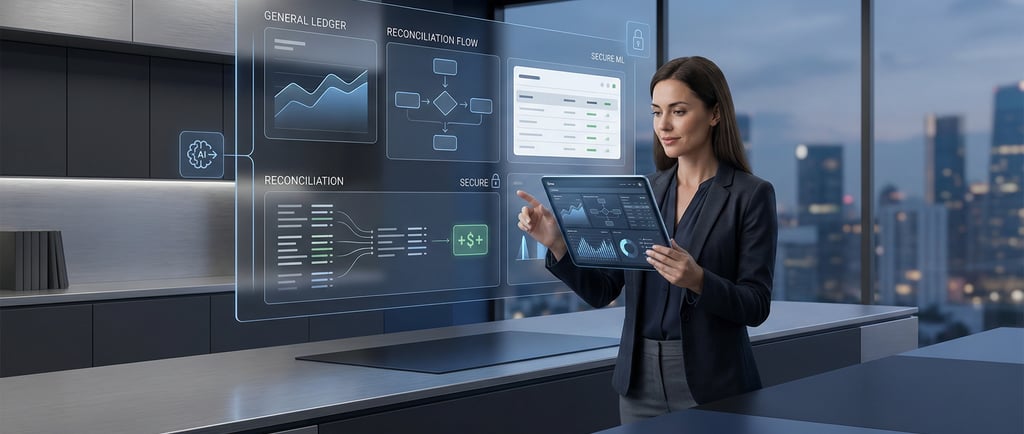
The accounting world is currently standing at a crossroads. For decades, "automation" in finance meant rigid rules-based engines - if X happens, do Y ; If A is missing find B.
But we have entered the era of Agentic AI, where artificial intelligence doesn't just follow a script; it reasons, plans, and executes complex workflows.
From preparing full financial statements from a raw trial balance to performing line-item reconciliations that once took days, AI agents are no longer a "future" concept. They are here, and they are transforming the very nature of the accounting close.
The Rise of the Financial AI Agent
Unlike standard chatbots, Agentic AI refers to systems capable of using tools. Think of them as digital teammates. In the accounting context, this means an AI that can log into an ERP, fetch an invoice, compare it against a bank statement, and suggest the correcting journal entry.
The Claude Code and Plugin Revolution
Tech giants and LLM providers are moving fast. Claude Code, for instance, is increasingly being equipped with finance-specific plugins. These allow the model to interact with structured data like CSVs and Excel sheets with a level of "reasoning" that feels remarkably human.
Financial Statement Preparation: You can now upload a "random" or messy trial balance, and these LLMs can categorize accounts, apply mapping logic, and generate a draft Balance Sheet or P&L in seconds.
Reconciliation and Booking: New startups are building agents specifically for "Invoice-to-Pay" cycles. These agents don't just read the invoice; they "understand" the context of the spend, book it to the right GL code, and flag duplicates without human intervention.
These tools are undeniably excellent at reducing the "grunt work" that leads to accountant burnout. However, the stakes in finance are fundamentally different from those in software engineering.
The Accountant vs. The Engineer: Why the "Copilot" Model Fails Finance
There is a common argument that if a Software Engineer can use GitHub Copilot or Claude Code to write 40% of their codebase, an accountant should do the same with their ledger. This is a dangerous equivalence.
When an engineer uses AI, they are dealing with logic and syntax. When an accountant or FP&A analyst uses an LLM, they are dealing with Company Secret/Sensitive Data and Personally Identifiable Information (PII). An accountant is often the primary gatekeeper of a company’s most sensitive "leaks." If a spreadsheet containing employee salaries or a list of high-value debtors is fed into a generic LLM, that data has effectively left the enterprise perimeter.
Five Critical Roadblocks for Enterprise AI in Accounting
While the efficiency gains are tempting, five major issues remain unresolved in the general LLM space:
1. The Data Privacy Paradox
Most AI agents operate in the cloud. For a reconciliation to happen, your data must travel to the AI’s brain. This creates a massive surface area for potential breaches.
2. The Personal Data Leak
Accounting records are full of personal details - names, addresses, and PAN/Tax IDs. Generic AI agents often lack the "filters" to ensure this data isn't cached or utilized in ways that violate individual privacy.
3. The "Training" Dead-End
Most enterprise subscriptions promise: "We do not train our models on your data." While this sounds good for security, it is a double-edged sword. If the AI doesn't learn from your specific edge cases, your specific vendor quirks, or your unique chart of accounts, the system never actually improves for you. It stays a generic "stranger" to your business forever.
4. Sensitive Data Exodus
To get an LLM to "understand" a financial statement, you have to provide context. Often, too much sensitive metadata leaves the system to provide that context, making it nearly impossible to maintain a "Zero Trust" environment.
5. The Compliance Minefield
We are now governed by a "Syllable Soup" of regulations: GDPR (Europe), DPDPA (India), CCPA (California), and the emerging EU AI Act. Most generic AI agents are built for "general purpose" use and struggle to meet the strict "Data Residency" and "Explainability" requirements these laws demand for financial reporting.
A Better Way: The DimeSuite Philosophy
At Repodime Systems, we realized that the "agentic" future is only viable if it is built on a foundation of absolute security. This is why we developed DimeSuite.
We don't send your data to public LLMs. Period.
Instead, DimeSuite focuses on:
Customer-Specific ML Models: We deploy proprietary machine learning models that are dedicated to your business. They learn your patterns without ever sharing that intelligence with the outside world.
On-Premise/Private Cloud Security: Your sensitive financial data stays within secure AWS or GCP environments, often within your specific geographic region to ensure compliance with local laws like DPDPA.
Accountant-in-the-Loop: We don't believe in "unsupervised agents." We believe in tools that flag irregularities and provide clear insights, allowing the accountant to be the "Agent" who makes the final, audit-ready call.
Conclusion
Agentic AI is the most exciting development in accounting since the invention of the double-entry ledger. It has the power to make the "continuous close" a reality. But for the enterprise, "cool" isn't enough. It has to be compliant, private, and precise.
The future of finance isn't a generic chatbot. It’s a specialized, secure AI environment that respects the weight of the data it handles.
Note: All third-party product names and brands mentioned - including Claude Code, Copilot, Github etc, are trademarks of their respective holders and are used here solely for illustrative and educational intent to provide industry context and insights into the evolving AI landscape.
Contact information
Socials
© 2026 Repodime Systems. All rights reserved.


TM
Our ML Engine